Instagram DM Limitations Explained (And How to Work Within Them)
Every powerful tool has rules — and Instagram DMs are no exception. Instagram enforces a set of messaging limitations that, if you don't understand them, can catch your business off guard.
The good news: these limits are designed to prevent spam and abuse, not legitimate business communication. With the right approach, you can manage your customer messages efficiently while staying within Instagram's rules.
Here's what the main limitations are — and how professional businesses work with them, not against them.
Limitation 1: You Can't Send Cold DMs to Followers
One of the most important restrictions for API-based Instagram automation is that automated tools cannot arbitrarily send DMs to followers. You can't simply build a list of your followers and send a message to everyone.
This type of bulk outreach can be considered spam and isn't supported by Instagram's messaging API. API-based automation is primarily designed to manage interactions where the user has already initiated or engaged with the business.
From a business perspective, this isn't necessarily a disadvantage. Someone who has already interacted with your account or sent you a message has demonstrated some level of intent. These warm leads are often much more valuable than cold outreach, so your automation should focus on responding to these interactions quickly and effectively.
Limitation 2: A Professional Account Is Required
Access to the Instagram Messaging API and API-based automation requires an Instagram Business or Creator account. Personal accounts aren't supported for these API capabilities.
If you're still using a Personal account, switching to a Professional account is free. You can change your account type through Instagram's settings and choose either Business or Creator.
See our guide on Instagram account types for a detailed explanation of the differences and how to switch.
Limitation 3: Rate Limits on Automated Messages
Instagram limits how many messages an account can send within a specific time window. This Rate Limit is designed to prevent excessive or abusive messaging activity.
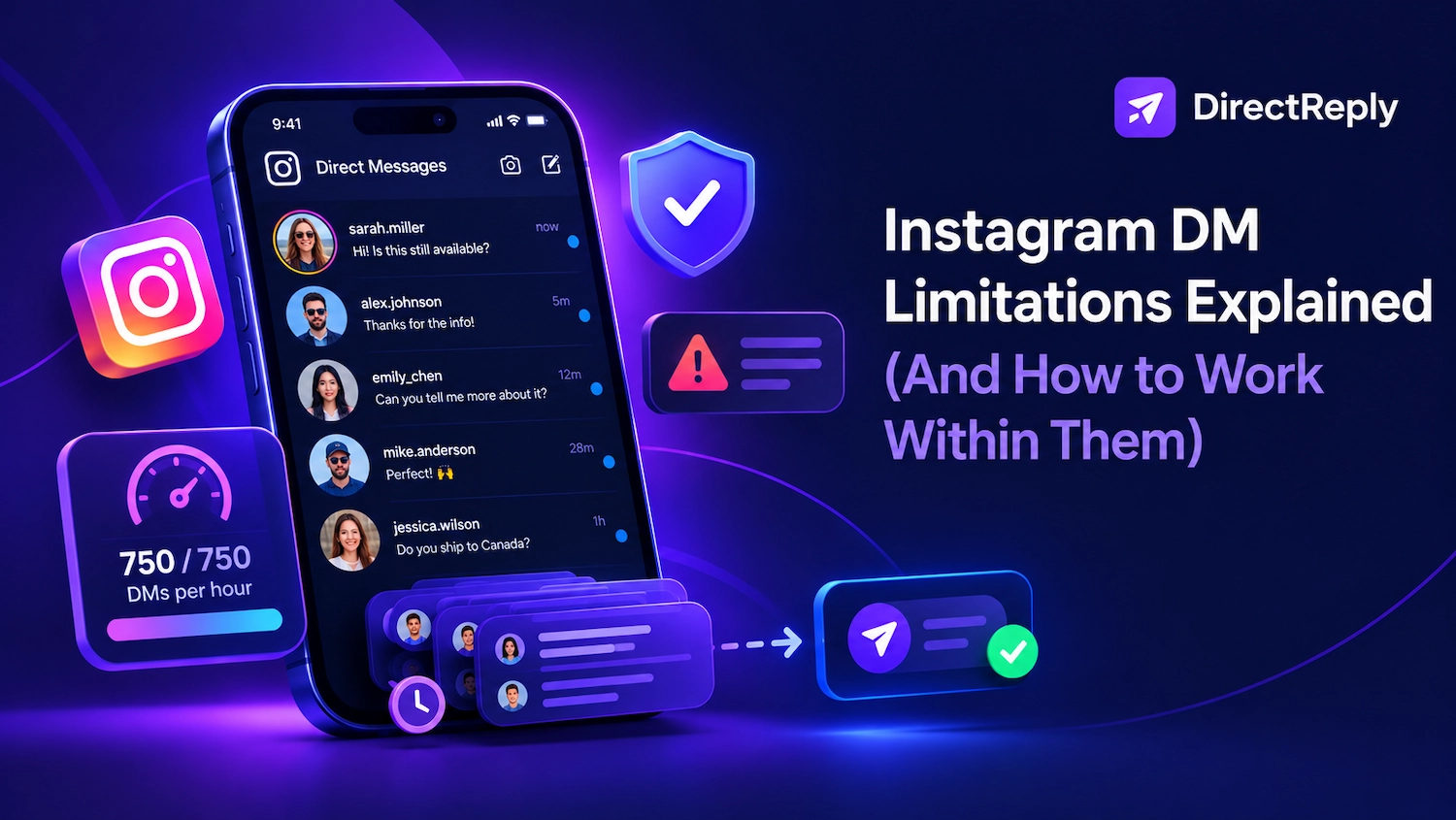
For example, in the scenario where DMs are sent to users who commented on a post, a page can send up to 750 DMs per hour.
For most businesses, this is more than enough. However, a successful campaign or a post with a large number of comments can sometimes cause many users to become eligible for a DM within a short period of time.
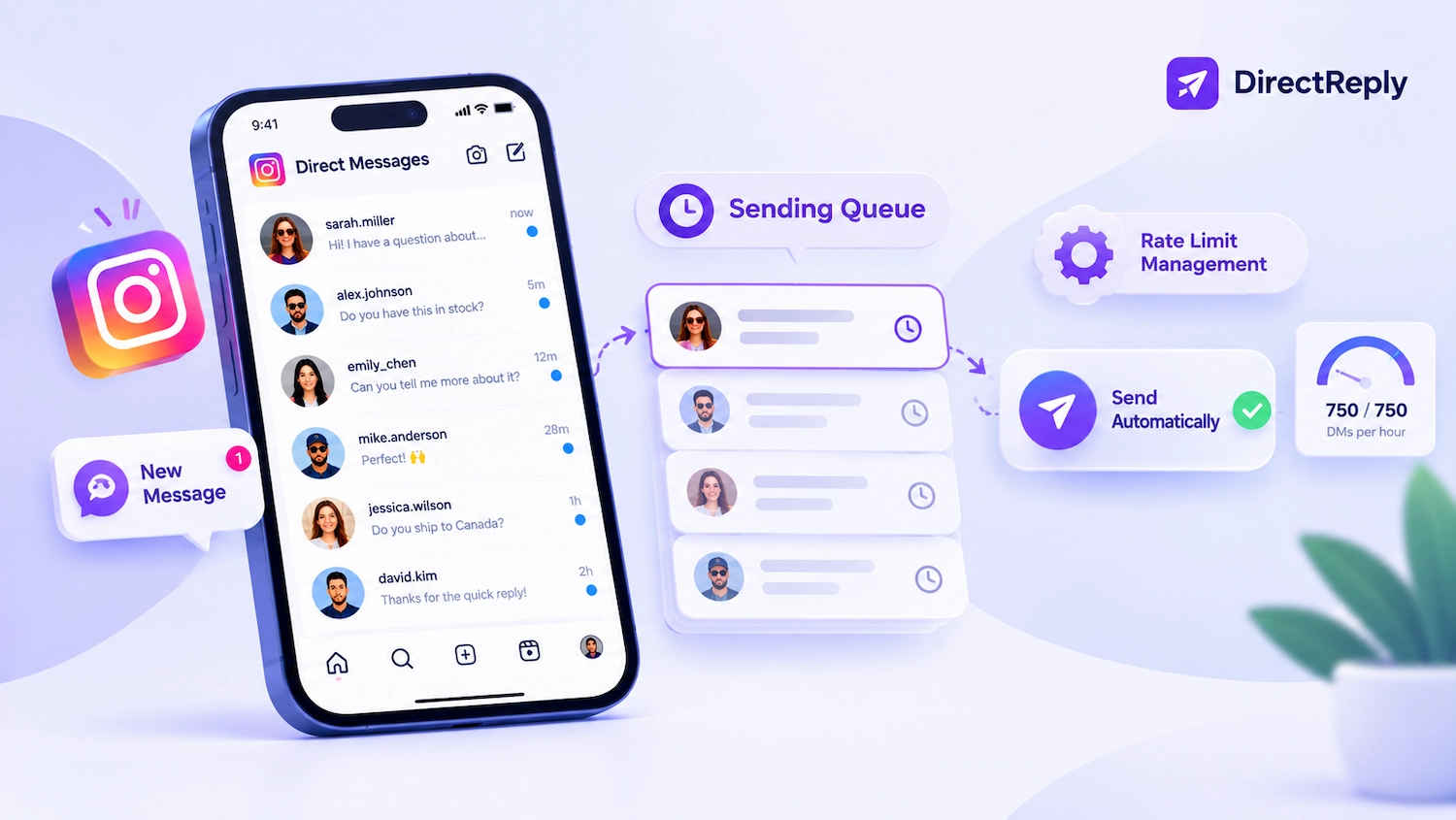
How to handle it: Direct Reply manages this limit automatically. Messages are placed in a sending queue and the system controls the sending volume so it doesn't exceed the available limit. If more messages are waiting than can currently be sent, the remaining messages stay in the queue and are automatically delivered as capacity becomes available.
This means that even during high-volume campaigns, you don't have to manually monitor the limit or worry about losing messages simply because many users became eligible for a response at the same time.
Limitation 4: Comments Cannot Be Liked via API
One well-known Instagram API restriction is that you cannot like comments programmatically. Comment likes are performed through Instagram's own interface.
However, the API supports several other useful interactions, including:
- Like an incoming direct message
- Reply directly under a comment
- Send a DM to someone who commented on a post, where supported
For most automation campaigns, this limitation isn't a major problem. Sending a DM to a commenter can be much more useful than simply liking their comment because it creates an opportunity to continue the conversation and guide the user toward the next step.
Limitation 5: Repetitive Messages and Spam-Like Behavior
Not every Instagram restriction is related to the API. Even when messages are sent manually, repetitive or unusual activity can increase the risk of temporary messaging restrictions.
For example, repeatedly sending the exact same message to many different accounts within a short period, sending large numbers of promotional DMs, or suddenly increasing the activity level of an account can look like spam-like behavior.
Instagram's systems don't necessarily look at one action in isolation. The overall behavior of an account can matter, including combinations of activities such as Follow, Like, Comment, and DM.
Behaviors that may increase the risk of restrictions include:
- Copying and sending the same message to a large number of users
- Sending many DMs within a short period
- Repeatedly messaging people who have never interacted with your account
- Repeating the same promotional message across many conversations
- Suddenly increasing the overall activity level of the account
- Performing large numbers of Follow, Like, Comment, and DM actions at the same time
- Receiving a high number of Blocks or Reports from users
This is also why there isn't a universal number such as "50 DMs per day is safe" or "100 DMs won't cause a restriction." Different accounts can have different circumstances, and Instagram may evaluate multiple signals and patterns when applying restrictions.
How to handle it: If you repeatedly send the same types of replies to customers, automation is a much better approach than manual copy-paste. Instead of repeatedly sending identical messages by hand, let a system built for Instagram's official messaging infrastructure handle repetitive incoming interactions.
When you already have an automation tool such as Direct Reply available, manually copying and sending the same messages to users simply adds unnecessary work and can increase the risk of creating spam-like activity patterns.
Limitation 6: Official API vs. Unofficial Automation Tools
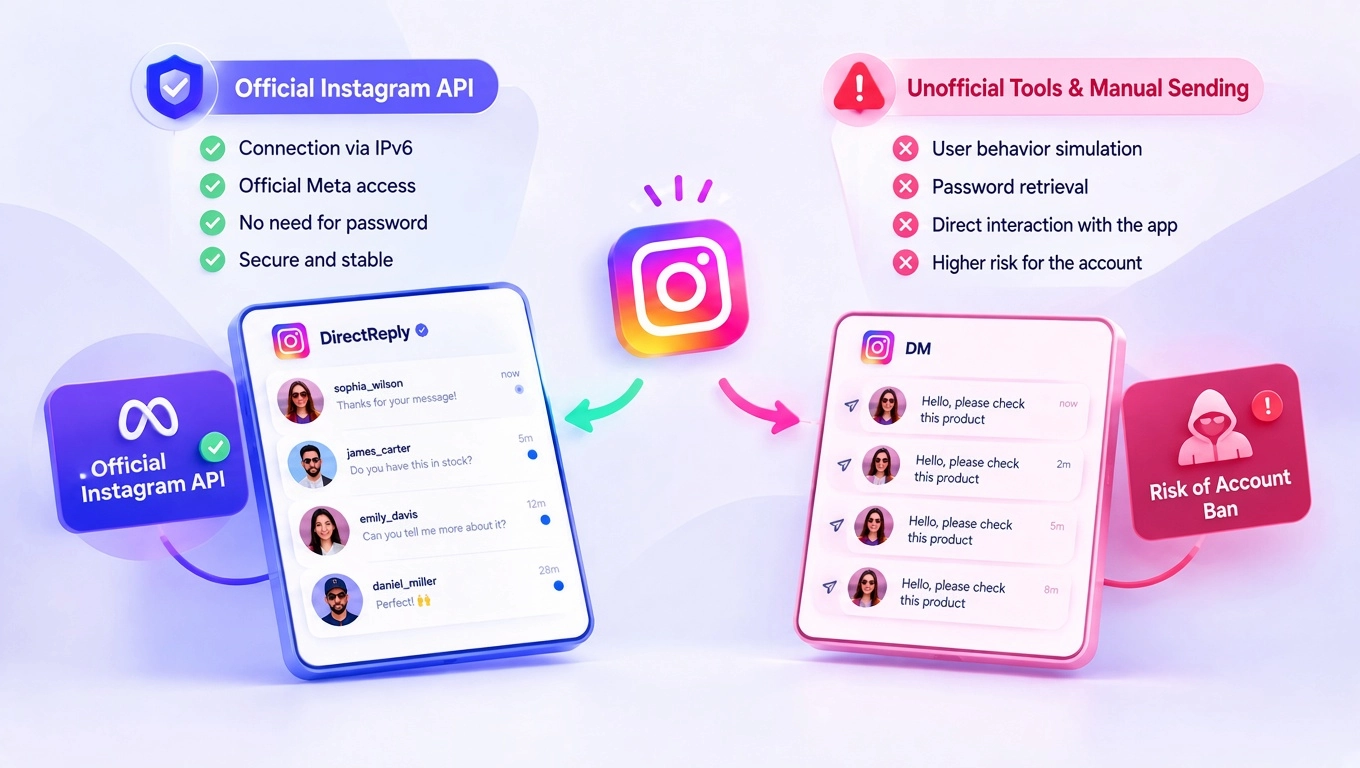
Not all Instagram automation tools work the same way. Some unofficial tools use methods such as browser automation, simulated user actions, storing your Instagram password, or other techniques that don't use Instagram's official API.
These approaches are fundamentally different from using the Official Instagram API and can carry higher account risk. Unofficial automation may result in suspicious-activity detection, feature restrictions, or other account problems.
Direct Reply uses the Official Instagram API. The account connection is established through OAuth and official Meta permissions, so you don't need to provide your Instagram password to Direct Reply.
Direct Reply's application and business have been registered within Meta's ecosystem, and the necessary permissions for its Instagram API functionality have been obtained. This means the automation operates through the official API infrastructure rather than by simulating the Instagram app or logging into the account through unofficial methods.
Of course, using the official API doesn't mean Instagram's rules can be ignored. Messaging limits, anti-spam policies, and platform requirements still apply. The key difference is that the automation itself operates through a communication method officially provided and supported by Meta.
Summary: Limitations at a Glance
| Limitation | Impact | How to Handle It |
|---|---|---|
| No arbitrary cold DMs | Can't send bulk DMs to followers | Focus on incoming interactions and warm leads |
| Professional account required | Personal accounts aren't supported for API automation | Switch to Business or Creator |
| Rate limits | Cap on messages within a time window | Direct Reply queues and manages messages automatically |
| No comment likes via API | Comment likes aren't available programmatically | Use comment replies or DMs where supported |
| Repetitive manual messaging | Can increase the risk of messaging restrictions | Use official automation instead of repetitive copy-paste |
| Unofficial automation | Higher account risk | Use the Official Instagram API |
Conclusion
Instagram's DM limitations aren't necessarily obstacles for businesses that operate correctly. Many of these restrictions exist to prevent spam and abuse while still allowing legitimate businesses to communicate with their customers.
The important thing is to understand the limits, avoid repetitive or spam-like manual activity, and use an automation method that is officially supported by Instagram.
With a Professional account, the Official Instagram API, and the right automation tool, you can manage incoming customer interactions efficiently while staying within Instagram's messaging rules.
See our complete Instagram DM automation guide to learn how to set up your automated messaging workflow.
Stay within Instagram's limits and never miss a customer message — try Direct Reply free
Related Posts